Table of Contents
Lions have long been a symbol of inspiration. Throughout history, people admired lions for strength, courage, and confidence.
Lions belong to the cat family; they are the second-largest cat species after tigers.
These majestic animals. Have powerful bodies and roaring sounds that can be heard five miles away.
How many types of lions are in the wild?
Lions can be grouped into main categories. The first category is African lions. ( Panthera Leo ) and Asiatic lions ( Panthera leo persica).
There are many classifications based on size, color, weight, adaptation, and even location.
However, all lions share many characteristics with one another worldwide.
What is the difference between male(lions) and female lions (lionesses)?
This is the best question to consider for the first safari-goer, whether in Africa or Asia.
The standard terms referred to in the bush are lioness (female) and lion (male).
The best way to distinguish is that only male lions develop manes.
The impressive fringe of long hair encircles their heads.
Despite that distinction, there are some exceptions.
Some mane-less lions have been observed in Africa. “Mane-less lion” is the best destination to see a species in Selous Game Reserve in Tanzania.
Additionally, juvenile lions have light spots on their skin that disappear with age.
Where do lions live? Lion Habits across the World
Lions are distributed across Africa, Asia, and Europe. Despite this distribution, fewer than 10% remain worldwide.
Most of these animals can be found in sub-Saharan Africa.
“Countries with high populations include. Tanzania, Kenya, Botswana, and Namibia. Zambia and South Africa, Uganda. And other countries like Angola, Congo, Rwanda, and Ethiopia”
Lions prefer to live in open grassland, scrub, and open woodland. This helps them move more easily while hunting their prey.
Lions can adapt to different environments, including rainforests and deserts.
The typical habitats of these two broad categories of lions are Africa and Asia.
The Panthera leo, or African lion, now lives in Africa.
Panthera leo persica, or the Asiatic lion, is found only in India, at Gir Forest.
Asiatic lions are very endangered and are well protected in the Gir forest. If the species could survive and thrive.
The high density of African lions is in Serengeti National Park. Masai Mara, Kenya, Ruaha National Park.
Okavango Delta ( Duba Island). Kruger National Park at Sabi Sands.
Etosha National Park in Namibia and Southern Luangwa in Zambia.
How does a lion hunt and live?
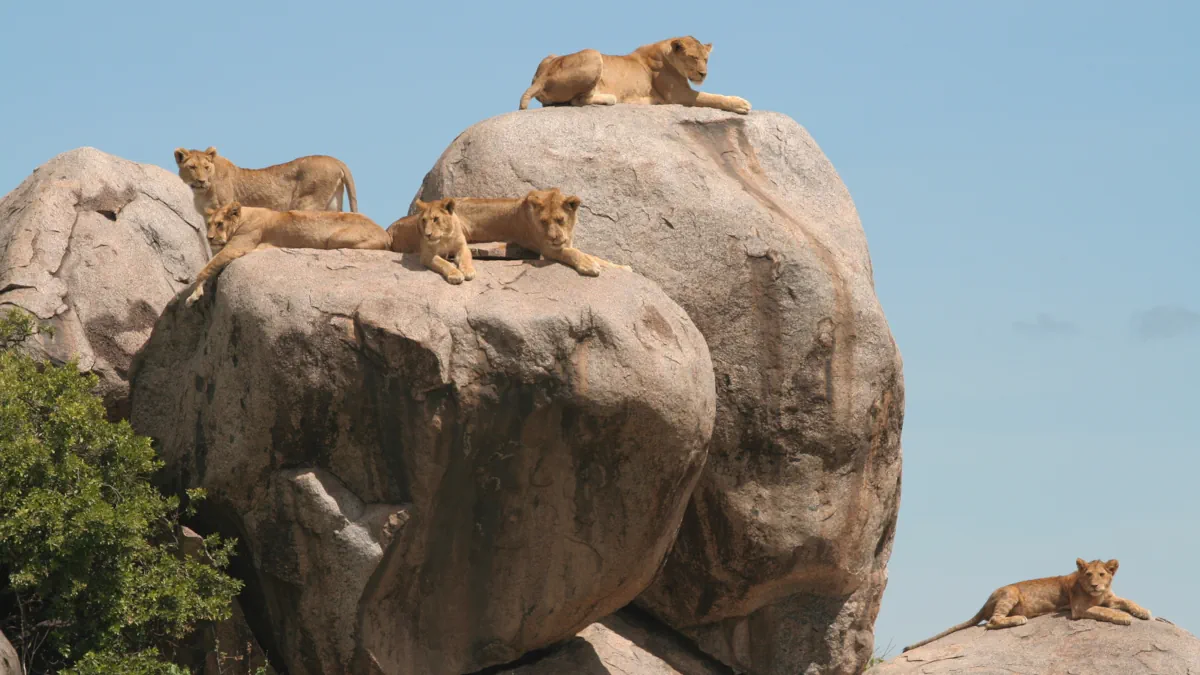
Lion groups are referred to as prides.
Lions are the only cat species with highly developed social behavior; they prefer to live in groups.
This pride lives together. Hunt together, raised cubs, and male lions protect the kingdom.
A pride can comprise 2 to 30 lions, or more.
While the number of adult males remains constant, with three or four males leading the pride.
Lionesses can be a dozen, and their cubs. It’s common for young males to leave the group to establish their pride.
The conquest of other groups led by other Lions is the only way to start their pride.
Despite being so social, there is one species of solitary lion. This behavior is observed among the Samburu in Kenya. The lions of Samburu.
What are the roles of Male lions v/s female lions (lionesses)?
Male lions defend the territory
Lions use urine to mark their territories against intruders.
The scent left by urine sends signals to intruders that the “Kingdom is under control.
Additionally, the roaring serves as a warning signal to other animals.
Lionesses are hunters and leaders.
Lionesses work together to hunt zebra and wildebeest, as well as other large mammals in the wild.
Lionesses are faster than Male lions and can hunt together as a team.
“Raising cubs is the role of the lioness within the pride”
Eating within the group follows ranking orders.
Adult lions should eat first, and the young and cubs should eat last.
Time will determine when the young lions join the hunt.
One year or above is the preferred time for young lions to join the hunt.
Sometimes lions hunt alone or even steal from other predators, such as wild dogs.
What is the classification of lions?
Various scientists have defined sub-classes of lion prides to facilitate identification.
This classification can not be treated differently from the original perspective.
Rather than a deep understanding of variation. Either by size, location, color, or shape.
- African lions
- White lions
- Mane-less lions
- Asiatic lions
- Southwest lions or Katanga lions
- Maasai lions or Serengeti lions
- Abyssinian lions
- Black Maned- Lions – Kalahari Desert
Although these classes vary, most lions share common characteristics.
Like living in one pride, hunting and killing as others do. Territorial defense and so many other similar behaviors.
African lions
It is the second-largest lion in the world, with impressively long, bushy manes covering their heads and necks in male lions.
Their hair is golden and blond, with brown hues.
The advantage of bush hair is protection during fighting, whether for territorial defense or for food.
White lions
This distinctive class of white Lions makes its home only in one place on Earth—the only place in South Africa.
These lions are preserved at the Timbavati and Sanbona game reserves.
Since 1977, when the publication of Chris McBride’s book, The White Lions of Timbavati.
“The white lions have captured the attention of the world”
The existence of these lions results from genetic mutations known as leucism.
This group of lions is scarce in the wild.
Only in Timbavati Private Nature Reserve do white lions occur naturally.
Split into two forms. White with blue eyes and pink lips, noses, and pads, and brown eyes with black lips, noses, and pads.
These lions have been reserved for generations and are thriving in the wilds of Africa.
Mane-less lions
Yes! Mane-less lions of Africa. It remains a mystery to the scientific community how this happens.
Male lions develop fewer manes or none at all.
Maneless lions are sometimes born in the same litter as maned lions.
If your curiosity is piqued, visit the Selous Game Reserve in southern Tanzania, East Africa.
Asiatic lions
These are lions found in the Gir Forest in India. 94% of the lions in Asia have disappeared from the wild.
The few remaining are in India. A conservation effort is going on to restore their numbers.
This group of lions is scientifically known as Panthera leo persica.
They can live up to 16 years. They hunt and live in prides, as their African descendants do.
Southwest lions or Katanga lions
This is the king of the beasts, large in size and strength.
These types of lions were proclaimed King of the Jungle.
They live in various regions, including Zambia, Botswana, Angola, Zimbabwe, Namibia, and Zaire.
These lions have distinctive manes of hair around the head and neck.
The strength displayed by these lions is very fierce.
You can witness this if you are in Africa for a safari.
The lions on Duba Island in Botswana can also swim in deep water.
Visiting places like Chobe National Park in Botswana.
Here you can find a lion pride that can hunt even large Elephants.
Many incidents have been reported from 1985 to 2005.
Masai lions or Serengeti lions
These are the largest groups of lions that exist on Earth.
The Serengeti alone accounts for more than 3,000 lions.
The Masai Mara accounts for more than 2,400 lions.
These lions are referred to as East African lions (Panthera leo nubica).
These lions are available across the East African plains.
The Masai lions have adapted well to different environments, including low- and high-altitude environments.
They are described as having longer legs and less plump bodies. They lack curved backs, unlike other lion species.
The incredible display of manes as lions age is remarkable. Males have tufts of fur on their knees.
There is some correlation between these lions’ developing manes and altitude.
At high altitudes, they develop full manes compared to low altitudes.
Abyssinian lions
This is one of the rarest lion species remaining on Earth.
This group of lions was adopted in 1948 from the private zoo owned by Emperor Haile Selassie.
The two lionesses and five males were adopted during that time.
It claimed that these lions originated from Southwestern Ethiopia.
Unlike other lions, this species is shorter. And males have distinctive black manes.
Their manes extend from the shoulders to the stomach.
If you want to see the lions, the only place is a small park in Addis Ababa, Ethiopia
Black Maned- Lions – Lions of the Kalahari Desert
Black-maned lions of Kalahari are a rare and iconic species. They are built for endurance.
With longer legs and larger feet, these desert dwellers are the masters of dry land.
Black-maned lions are described with. Pale gold fur and males sport distinctive black manes.
The narration is quite different here; these lions do not consist of many mating pairs.
Like in Serengeti or Maasai Mara. However, a pride can consist of a single mating pair or a small pride of fewer than seven members.
These rare lion species are beautiful to lionesses as they contain higher levels of testrone.
The best place to see these lions is Kgalagadi Transfrontier Park.
This park spans northern Southern Africa and Botswana. It also shares the border with Namibia to the west.
What are the common characteristics of lions?
- They are carnivores. They depend on meat to survive ( prey )
- Live in groups commonly referred to as a pride
- Territory defense is the male lion’s role
- Fight and conquest are the way of life to establish their territories
- The life spans for lions are between 14 and 25 years
- Lions are very social, and lionesses are the leaders of the group
- Lions kill and destroy the male cubs of other prides during the conquest
- All lions belong to the genus Panthera andthe Felidae family
Which part of the world has a high population of lions?
Sub-Saharan Africa is the only place with a high number of lions on Earth.
You can either visit the Masai Mara in Kenya or the Serengeti in Tanzania.
The best time to see lions in these areas is during the wildebeest migration, from July to October.
You can also visit the Okavango Delta in Botswana. Sabi and Sands in Kruger National Park, or even visiting Zambia and Etosha in Namibia.
Lion’s count will make you feel excited.
Africa is home to these wildcats; the vast landmass and abundant food ensure their survival.
What is the significant threat to the survival of lions in the wild?
According to the International Union for the Conservation of Nature (IUCN).
Classified lions are as vulnerable to extinction.
“In Africa, the estimates show that less than 25,000 lions remain. The drop is almost 50% compared to 20’s years ago”
Lions across the globe face different challenges. Most of these threats can be attributed to human activities and developments.
- Fear of lions attacking livestock has led to conflict between ranch owners and lions. They use chemicals, guns, and even poison to kill lions.
- Poaching activities for the illegal use of lions. Their bones and other body parts have been valuable in illegal wildlife trading.
- Uncontrolled hunting. There is a misconception about the hunting business in many parts of the world.And especially in Africa. Have put the lion species on stake.The amount paid for killing lions does not compensate for the lives lost by these kings of the jungle.
- Competition between humans and wild animals.Many controlled areas have attracted large numbers of people.Either for tourism or other development activities in Africa.And other parts of the world. Human intervention in wildlife harvesting.The bushmeat trade is a threat to the lion population.
The survival of lions depends on the availability of prey.
Statistics show a 52% decline in the food chain in East Africa and an 85% decline in West Africa.
- Our final remark is that the food chain is disrupted. Lions will turn to domesticated livestock.
How to conserve the lion population?
Sustainable conservation is the only option that will rescue lions.
From total extinction in Africa or elsewhere in the world.
We acknowledge the ongoing efforts of many conservation societies and organizations.
The awareness and participation programs in Africa. Is the key to lions’ survival.
A mega project such as the Serengeti lion project in Tanzania is a viable example.
But also international organizations, including. World Wildlife Fund (WWF).
African Wildlife Fund (AWF). Wildlife Conservation Societies (WCS).
And government organizations like TANAPA, KENAPA, and many others in Africa.
The conservation of lions requires joint support from the grassroots to the global level.
Offering models that support communities’ welfare. It will help to create lion ambassadors in our communities.
( Refer to the wildlife project in the Masai Mara in Kenya)
Extension of national parks and game-controlled areas. This is another effective strategy for the conservation of lions.
We acknowledge notable projects, such as those in the Zambezi Delta and the Selinda area in Botswana.
Conclusion
We are a more civilized community than our forefathers.
Is now the right time to use our advanced technology to ensure the survival of lions?
We either let our generation enjoy what we have found on Earth, or we become selfish and destroy what remains.
Let the sound of “SIMBA” roar from afar as we tell stories of our people.
Together,r we can make lions thrive and live in the wild.
In case you need any help with planning your East Africa safari.
Our team will be happy to assist in designing the bespoke safari experience for you.
Feel free to contact the Blessing Safaris Team today!