Kilimanjaro Glaciers
Kilimanjaro glaciers may appear as static white fields, but they are constantly changing and provide valuable insights into Earth’s climate history. They represent survival, change, and adaptation.
It might seem unusual to find glaciers at the equator, since there is intense sunlight year-round, but the glaciers on Kilimanjaro have survived for thousands of years because their bright white surfaces reflect most of the sun’s heat.
The albedo effect, this reflective property, causes ice to reflect 80 to 90 percent of sunlight and thus helps protect it from melting.
But this mechanism, which enables survival, is incomplete; the dark lava rock beneath the glaciers absorbs heat and thus melts the ice from below, reducing the glaciers’ stability.
This results in unstable overhangs and cracks, which expose more rock and accelerate melting. It is these processes that have given rise to Kilimanjaro’s characteristic ice formations.
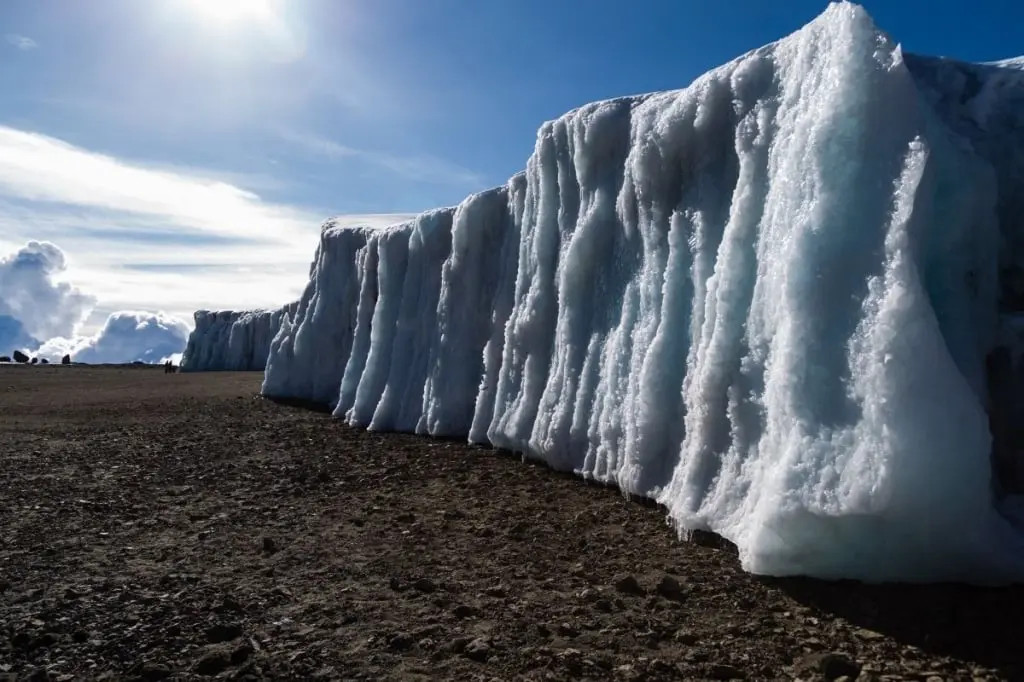
The Furtwängler Glacier is one of Mount Kilimanjaro’s most striking and threatened natural features. This large ice formation, located at the summit of Africa’s highest peak, endures intense equatorial sunlight year-round
The Formation and History of Kilimanjaro Glaciers
The Origins of Ice on the Equator
Scientists believe Kilimanjaro’s glaciers started forming about 11,700 years ago, around 9700 BC. Before that, the mountain may have been ice-free for as long as twenty thousand years. The glaciers formed when the world cooled, allowing ice to persist at high altitudes near the equator.
The Role of Ice Ages
Kilimanjaro’s glaciers have survived thanks to repeated cold spells, or ice ages, over time. Scientists think there have been at least eight major ice ages since the glaciers first appeared. These cold periods helped the glaciers regrow and spread after melting during warmer periods.
The most recent significant cold period occurred during the fifteenth and sixteenth centuries, a time often referred to as the Little Ice Age. During this period, the Thames River in England frequently froze over, and winters across Europe were particularly severe.
On Kilimanjaro, the glaciers extended dramatically during this time, with ice reaching down to the tree line in places. Both Mawenzi and Kibo would have been covered in ice during this period, with the glaciers at their most extensive in recent history.
Long-Term Climate Patterns
Kilimanjaro’s ice has come and gone many times. Before 9700 BC, the mountain may have been ice-free for as long as 20,000 years. These changes in ice cover show how the climate has shifted over the last hundred thousand years. Now, we are seeing another major change, but this time it is happening faster due to human actions.
How Glacier on Kilimanjaro Survives
The Albedo Effect
The primary survival mechanism for Kilimanjaro’s glaciers is the albedo effect—the ability of white surfaces to reflect solar radiation. The brilliant white color of the ice reflects approximately 80-90% of the sun’s heat, preventing significant surface melting even under the intense equatorial sun. This reflective property is so effective that the glacier surface remains relatively unaffected by direct sunlight, despite the equator’s powerful rays.
The Underlying Melting Process
While the glacier’s surface reflects heat, the dark volcanic rock beneath absorbs it, warming the rock and melting the ice from below. This process results in several effects:
- Overhang formation: With the base melted away, the ice at the top remains, creating overhanging structures.
- Loss of grip: The ice at the bottom melts, causing the glacier to lose its grip on the underlying rock
- Fracturing: As the process continues, the ice fractures and breaks away
- Exposure: Breaking ice exposes more rock to the sun, accelerating the cycle
The Creation of Spectacular Structures
The sun’s effect on the glaciers has created some of Kilimanjaro’s most spectacular features. The melting process, combined with the freezing and refreezing of meltwater, has formed:
- Ice columns and pillars: Vertical structures shaped by differential melting
- Ice towers: Dramatic formations rising from the glacier surface
- Ice cathedrals: Grand structures resembling the architecture of cathedrals
- Overhangs: Dramatic projections where ice has melted from below
These features are among the most striking on Kibo’s upper slopes, giving the area its unique, sculpted look.
The Rapid Retreat of Kilimanjaro’s Glaciers
Historical Shrinkage
Kilimanjaro’s glaciers have been retreating dramatically over the past century. Scientific records show:
- 1912: The ice cover was extensive, with glaciers covering a significant portion of the summit
- 1912–1953: Glacier surface area shrank by approximately 1% annually
- 1989–2007: The shrinkage rate accelerated to approximately 2.5% per year
- 1912–2000: Glaciers had shrunk by approximately 85% overall
- 2000–2009: An additional 26% of remaining ice disappeared
The Southern Icefield
The Southern Icefield, which includes Rebmann, Furtwängler, Kersten, and other glaciers, has been especially affected. Many now exist only as remnants, and the once-continuous icefield is reduced to isolated patches.
The Northern Icefield
The Northern Icefield has also retreated significantly. Most glaciers have disappeared, half of the Furtwängler Glacier has receded, and only small ice masses remain near the crater rim.
Other Glaciers and Ice Features
Kersten Glacier
Kersten Glacier, adjacent to Heim Glacier on the right side of the Southern Ice Field, has experienced significant retreat, similar to Heim Glacier.
Balletto Glacier
Balletto Glacier, visible from Barranco Camp on the left side of the valley, is part of the glacial system that once covered Kilimanjaro’s southern slopes.
Diamond Glacier
Diamond Glacier is located near Reinhold Messner’s climbing route on Kilimanjaro. Messner, a renowned Italian mountaineer, passed near this glacier during his ascent.
Little Penck Glacier
Little Penck Glacier, on the west side of Kilimanjaro, is a remnant of a once-larger glacier system.
Great Barranco Glacier
Great Barranco Glacier, on the southwest edge of Kilimanjaro’s glacial system, has also experienced significant retreat and is now much smaller.
Predictions for the Future
Scientists predict that Kilimanjaro’s remaining glaciers may disappear entirely by 2030 or 2040 if current rates of retreat continue. Some studies suggest that even the most optimistic projections point to total ice loss within a few decades. The disappearance of these glaciers would have profound implications for:
- Scientific research: The loss of valuable climate records
- Tourism: A significant reduction in the mountain’s visual appeal
- Local communities: Impact on water resources and tourism-dependent livelihoods
- Environmental awareness: The loss of a powerful symbol of climate change
Global Warming and Climate Change
The Impact of Rising Temperatures
Global warming is accelerating the retreat of Kilimanjaro’s glaciers. Rising temperatures are increasing both surface melting and basal melting.
While glaciers have survived previous warm periods, the current warming is occurring at an unprecedented rate, likely outpacing their ability to regenerate during cold spells.
The Equatorial Context
Kilimanjaro’s position near the equator makes its glaciers particularly vulnerable to climate change. The equatorial sun is intense, and small changes in temperature or precipitation can have significant impacts on ice stability. The glaciers’ location also means they cannot benefit from the seasonal snowfall that sustains glaciers at higher latitudes.
Broader Implications
The retreat of Kilimanjaro’s glaciers is not an isolated phenomenon. Glaciers are melting across the globe, from the Himalayas to the Andes to the Alps. The loss of these glaciers has global implications for sea level rise, water resources, and biodiversity.
Kilimanjaro’s glaciers serve as a visible, accessible symbol of these broader changes, bringing climate change to the attention of the millions of visitors who climb the mountain each year.
Frequently Asked Questions About Kilimanjaro’s Glaciers
Does Kilimanjaro Still Have Glaciers?
Yes, but they are rapidly disappearing. Kilimanjaro still retains some glaciers, including parts of the Northern Icefield, Furtwängler Glacier, and remnants of the Southern Icefield. However, the glaciers have shrunk by approximately 85% since 1912, and scientists predict they may disappear entirely by 2030 or 2040.
Why Are There Glaciers on the Equator?
Kilimanjaro’s glaciers exist at the equator because of the mountain’s extreme altitude. At 5,895 meters, the summit is high enough to maintain freezing temperatures year-round. The brilliant white color of the ice also reflects most of the sun’s heat due to its high albedo, helping the glaciers survive despite the intense equatorial sun.
How Did Kilimanjaro’s Glaciers Form?
The current glaciers began forming around 9700 BC, following an ice-free period. Their formation was made possible by global cooling trends, with the most significant ice extensions occurring during cold periods such as the Little Ice Age in the fifteenth and sixteenth centuries. The glaciers have expanded and retreated multiple times throughout history in response to climate changes.
What Causes Kilimanjaro’s Glaciers to Melt?
The primary cause is heat from the dark volcanic rock beneath the glaciers. As the rock absorbs sunlight, it warms the ice from below, causing it to melt and form overhangs. Global warming now accelerates this process by increasing both surface and basal melting.
What Is the Furtwängler Glacier?
Furtwängler Glacier is one of the largest remaining glaciers on Kilimanjaro, located on the Kibo Crater. Named after Walter Furtwängler, who climbed the mountain in 1912, it has shrunk dramatically over the past century, with half of it having receded. It remains one of the most visible glaciers on the mountain.
What Is the Southern Icefield?
The Southern Icefield was a collection of glaciers on Kilimanjaro’s southern slopes, including Rebmann Glacier, Heim Glacier, Kersten Glacier, and others. It was once a continuous expanse of ice but is now reduced to isolated remnants. The Southern Icefield is visible from the southern circuit, particularly from Karanga Valley and Barranco Camp.
What Is the Northern Icefield?
The Northern Icefield is situated on the northern side of Kilimanjaro’s summit. Like the Southern Icefield, it has undergone significant retreat, with most glaciers gone and half of the Furtwängler Glacier receded. Ice near the crater rim is no longer connected to the glaciers, and only small ice masses remain on the slopes.
When Will Kilimanjaro’s Glaciers Disappear?
Scientists predict that Kilimanjaro’s remaining glaciers could disappear entirely by 2030 or 2040 if current rates of retreat continue. While some projections are more optimistic, most experts agree that the glaciers will be gone within a few decades without significant climate action.
What Is the Albedo Effect?
The albedo effect refers to the ability of white surfaces to reflect solar radiation. Kilimanjaro’s glaciers survive at the equator because their white surfaces reflect approximately 80-90% of incoming sunlight, preventing significant surface melting. The dark volcanic rock beneath, however, absorbs heat, causing melting from below.
How Are Kilimanjaro’s Ice Formations Created?
The spectacular ice formations on Kilimanjaro—including columns, pillars, towers, and cathedrals—are created by differential melting. As heat from the sun-baked rock melts the ice from below, and surface melting occurs in some areas while others remain intact, the glaciers develop intricate structures. Freezing and refreezing of meltwater also contribute to these formations.
Why Are Kilimanjaro’s Glaciers Important?
Kilimanjaro’s glaciers are significant because they contain valuable climate records, support tourism and the local economy, symbolize climate change, and contribute to the mountain’s unique ecosystem and visual identity.
What Can Be Done to Save Kilimanjaro’s Glaciers?
While existing damage cannot be reversed, reducing greenhouse gas emissions can slow glacier loss. Supporting renewable energy, promoting sustainable practices, protecting the mountain’s environment, and raising awareness of climate change are all important. However, many scientists believe some ice loss is now inevitable.
Plan Your Kilimanjaro Trek
Despite the disappearance of its glaciers, Kilimanjaro remains an exceptional destination. Whether you plan to summit or view the remaining ice formations, the mountain offers a memorable experience.
Our team designs personalized Kilimanjaro itineraries that allow you to view the remaining glaciers and support conservation efforts. We provide experienced guides, quality equipment, and comprehensive support.
Contact us to discuss your Kilimanjaro climb and experience Africa’s highest peak while its remaining glaciers are still present.
Mount Kilimanjaro Tour Packages
From$2,250
9 Days, 8 Nights
9 Days Northern Circuit Route
Mt. Kilimanjaro
From$2,520
10 Days, 9 Nights
8 Days Lemosho Route
Mt. Kilimanjaro
From$ 2,230
9 Days , 8 Nights
7 Days Machame Route
Mt. Kilimanjaro
From$2,250
9 Days, 8 Nights
7 Days Lemosho Route
Mt. Kilimanjaro