Table of Contents
Do you want to climb Kilimanjaro but don’t know where to start? Then this article is for you.
We have compiled many questions and all the ideas related to Mount Kilimanjaro.
All this information will help you understand the entire Kilimanjaro climbing process.
It does not matter what level of experience you have with mountains. Mount Kilimanjaro is for everyone.
Whether you are a seasonal climber or a beginner on Kilimanjaro.
The success rate for our clients is excellent. The summit of Africa is waiting for you.
Now, let’s begin our journey of discovery into this highest peak in Africa.
How to climb Kili for beginners and experienced mountaineers alike.
Where is Mount Kilimanjaro?
Mount Kilimanjaro is located in northern Tanzania in East Africa. It’s bordered by Kenya to the south.
The nearby towns are Moshi and Arusha. Tanzania was formerly known as Tanganyika during the colonial era.
This free-standing mountain on Earth is also 200 miles south of the Equator. The well-known time zone is +3 GMT.
Mount Kilimanjaro is one of the volcanic mountains formed around 750,000 years ago.
Mount Kilimanjaro is as old as the Great Rift Valley. Standing tall above the African sky, it is 19,340 ft (5,895 m) above sea level.
Making it the highest summit in Africa and one of the Seven Summits worldwide.
How tall is Mount Kilimanjaro?
Mount Kilimanjaro is 5,895 meters above sea level (19,340 feet).
It is the highest free-standing mountain on Earth, with three peaks: Kibo, Mawenzi, and Shira.
Kilimanjaro ranks fourth among the Seven Summits, behind Mount Aconcagua (6,961 meters) in South America and Mount McKinley (also known as Denali, 6,194 meters) in North America:
Why is climbing Kilimanjaro so difficult?
Many reasons could be given for that, but the most common are elevation and oxygen levels.
At the summit of Kilimanjaro, the amount of oxygen available can drop to 50% of that at sea level.
A low level of oxygen can stress the body and cause altitude sickness.
Climbing tip. Gradual ascent decreases the risk of altitude sickness; climb slowly and don’t stop. Drink plenty of water, too.
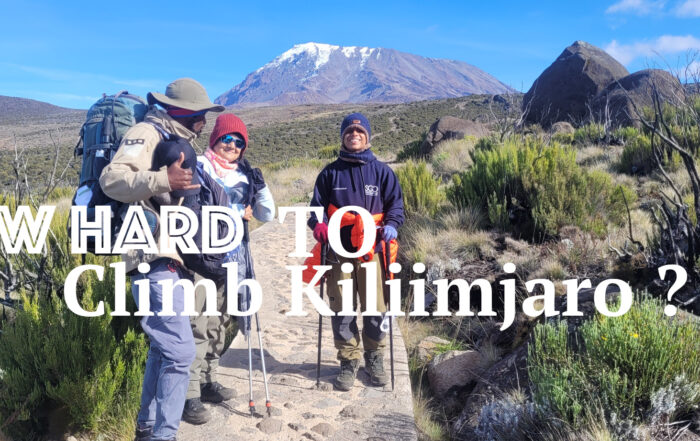
How hard is it to climb Kilimanjaro?
The direct answer is that it depends on the climbing route.
It’s common for operators to convince clients to take the shorter route, such as the 5-day Marangu climb.
Either because of the budget or the time limits.
But the truth is, for climbers who opt for more than 7-9 days, their success rate is 80-90%.
Compared with the success rate on Kilimanjaro over 5 or 6 days of climbing, the success rate is below average.
For instance, the 5-day Marangu Route has a 27% failure rate. This is because climbers do not have enough time to acclimatize.
Compared with others who take other routes, such as the Lemosho route.
How long does it take to climb Kilimanjaro?
Each route takes a different number of days to reach the summit of Kilimanjaro.
The shortest route is Marangu, which can be completed in 5 or 6 days.
Other routes, such as the Lemosho or Machame routes, take 7-9 days to reach Kilimanjaro’s summit.
There are six routes that originate from different points around the mountain and converge at the peak of Kilimanjaro.
Is it necessary to have a mountain guide for Kilimanjaro?
It’s directives from the Kilimanjaro National Park Authority.
Each climber must be accompanied by a licensed mountain guide.
In addition to the guide, you should also have a crew of porters, a cook, and an assistant guide.
What makes Mount Kilimanjaro famous?
There are many reasons Kilimanjaro is famous.
First, it is the highest free-standing mountain on Earth and the tallest peak in Africa.
The second reason is the presence of permanent glaciers year-round.
Despite being set in warm, tropical regions, “Third,” The Snows of Kilimanjaro (1952).
This movie was inspired by Ernest Hemingway’s short stories from 1936.
But Mount Kilimanjaro is also among the “Seven Summits”.
Though coming in at rank behind Denali (6,194 m) and Mount Aconcagua (6,961 m).
Yet it is Africa’s highest summit at 5,985 m.
Does climbing Kili require technical skills?
The answer is no. The entire climb of Kilimanjaro is hiking.
There is no risk of falling rocks or steep drop-offs along the trails.
Very few places require much effort to cross, and those that do are minor during your hike.
You will experience long walks and treks, which are good for your health.
What are the risks associated with climbing Kilimanjaro?
The risk of danger is quite low compared to other mountains worldwide.
Kilimanjaro reports a low death rate of fewer than 10 deaths per 30,000-35,000 climbers each year.
Many sources and operators report that acute mountain sickness (AMS) is the main cause of death.
Having the right team and well-trained guides helps ensure your safety while on the climb and for the whole crew.
Focus on reasonable prices rather than a cheap option. Read more about Mountain Sickness.
Is fitness required to climb Kilimanjaro?
You don’t have to be a pro athlete or superhero.
You should take care of your body and maintain a reasonable level of fitness.
You should prepare, get in shape, and don’t underestimate the climb.
As we mentioned earlier, Kilimanjaro is suitable for all.
Beginners do very well at hiking, just as seasonal climbers do. You should set aside time to prepare.
Burn some calories, and let’s meet when you’re fit enough to reach the summit of Africa.
When is the best time to climb Kilimanjaro?
Tanzania has two seasons. The dry season runs from June through October and continues through December and February.
The wet season occurs in November, March, April, and May. We don’t recommend climbing during this time.
The risk is high for our clients and our team.
We have covered this topic in detail in this article, “Weather on Mount Kilimanjaro: What to Expect.”
What types of accommodations are available in Kilimanjaro?
Climbing Kilimanjaro offers two accommodation options, tents and mountain huts.
Mountain huts are available only on the Marangu route.
While other trails offer only mountain tents. We provide sleeping bags and sleeping pads (mattresses)
Is Kilimanjaro very cold? How cold does it get?
You should forget the assumption that Kilimanjaro is in Africa because it could be hot there.
At higher altitudes, this mountain can be cold and windy at night.
The coldest temperature you could experience ranges from 20°F to -20°F (-7 °C to -29 °C).
Below the freezing point, which is 0 °C, layering a proper diet is the key to keeping you warm here.
How about meals during the Kilimanjaro climb?
This is a good question about what you eat when climbing Kilimanjaro.
We offer a variety of dishes typical of Western cuisine.
These are foods you might be familiar with, such as spaghetti with sauce, fried chicken with fries, beef stew with potatoes, and curry with rice.
Sometimes we offer local dishes like ugali and cabbage.
We offer professional cooking for all your dishes while on the climb. Eat well and have enough energy for the hike.
Are we allowed to have campfires on Kilimanjaro?
Campfires are not allowed on the mountain. It’s also against sustainable conservation.
But also, there is not enough wood to support an open fire. We carry cooking gas for meals prepared at the campsite.
How about toilets on Kilimanjaro?
There are public toilets at each campsite and even a few on the trail. To be true, they are filthy.
By request, we provide your own private, portable toilet. The small tent, shaped like a phone booth, offers privacy.
We set up these tents at every campsite. Read more about toilets on Mount Kilimanjaro.
How about showers during the Kilimanjaro climb?
There may be showers during your climb. You can bring wet wipes and towels.
The mountain is very cold, and the water supply is scarce. You can request some water from our team to rinse off here and there.
Otherwise, keep cool and move on. You might smell a little, but so will everyone else. Hakuna Matata!
What is the climbing cost for Kilimanjaro?
Kilimanjaro prices vary from one operator to another. There are budget, mid-range, and luxury operators.
All these companies play a major role in determining the cost of climbing.
The most popular routes that start at 8 days cost $2,900 to $3,000.
Other budget operators can offer the same route for under $2,000.
While luxury companies sell for $6,000 and above.
Here is the trick: don’t be swayed by low prices from cheap operators.
Remember, this is your lifetime vacation. You could have dreamed of it for years.
Kilimanjaro is not cheap; any service provider offering it at a low price is not reliable.
Should be compromising other services, which will affect your success in climbing.
Reliable companies pay competitive salaries and employ the best-trained guides.
To handle all emergencies that may arise during your expedition.
We pack enough food, the best crew, and the best climbing gear.
Do your research. Read more about Kilimanjaro’s climbing cost.
How about climbing gear for Kilimanjaro?
Climbing Kilimanjaro requires adequate preparation for the climbing gear.
You should have enough items to take you through all the weather conditions.
Sometimes you need to wear light clothes on a day hike. But if conditions change, you should switch gears.
Different types of clothing are needed to keep you warm and dry at all times.
You need waterproof, insulated, breathable fabrics. Also, sleeping bags, day packs, duffel bags, and good footwear.
We provide tents. Check our recommended pack list for Kilimanjaro.
Booking a Kilimanjaro Guide
Before deciding to visit Tanzania to climb Mount Kilimanjaro.
You should make sure you have selected a reliable tour operator to organize your trip.
It’s worth booking with a local tour agency to help guide you along the way.
You should know that, if it’s your first time on Mount Kilimanjaro, reaching 5,895 meters is not a picnic.
Most hikers succeed thanks to the best guides, who are well-experienced with the trails and weather of this mountain.
Experienced Kilimanjaro guides are well-equipped with skills in altitude sickness and prevention, climbing routes, leadership, and guiding ethics.
The reliability of the travel agency is key to your success rate.
Avoid cheap operators; they are after small profits with less care.
You should know that climbing Mount Kilimanjaro is not cheap.
We have covered this topic in our article on the cost of Kilimanjaro climbing.
Do your homework and book with a reliable tour operator who can guarantee the best service and crew for your Kilimanjaro climb.
All our Kilimanjaro guides are certified Wilderness First Responders (WFR).
We also work with helicopter evacuation services and KINAPA for emergency rescue.
Your safety comes first during your Kilimanjaro climb with Blessing Safaris.
How to visit Mount Kilimanjaro
The first step to reaching Mt. Kilimanjaro’s summit is to fly into Tanzania, Africa.
Although there are several airports in the country, the most direct and practical option for reaching your destination is Kilimanjaro International Airport.
There are many ways to visit Mount Kilimanjaro, depending on your country of origin and available modes of transport.
If you’re flying to Tanzania, there are several airports in the country, though Kilimanjaro International Airport (JRO) is recommended.
However, arriving at another airport does not prevent you from climbing Kilimanjaro.
You can arrive at Julius Nyerere International Airport in Dar es Salaam.
Jomo Kenyatta Airport in Nairobi, Kenya; Zanzibar Airport; or a small airstrip in Arusha. Do what is convenient for you.
There is a lot of accommodation in either Moshi or Arusha.
It’s ideal to have a place to stay before and after climbing Mount Kilimanjaro.
If you need help, feel free to contact our team.
What are the best routes to the summit of Kilimanjaro?
Mount Kilimanjaro offers six routes for ascent and descent.
These routes differ in terms of climbing days, cost, difficulty, and comfort.
The view from each route is quite different from the others.
But at the end of the climb, you reach the same peak, “Uhuru Peak,” or the summit of Mount Kilimanjaro, at 5,895m above sea level.
This is a brief overview of these Kilimanjaro climbing routes.
We have a dedicated page for Mount Kilimanjaro climbing routes and packages.
Lemosho Route- Mount Kilimanjaro
The Lemosho route is among the best routes for climbing Mount Kilimanjaro.
This route has the highest success rate of any route on Kilimanjaro.
You can spend seven (7) or eight (8) days reaching the summit of Kilimanjaro.
Expect to cover about 43 miles on your trip to Kilimanjaro.
This route is also more expensive than the others.
The average cost for a solo climber is $3,200, and group sharing can reduce it to $2,560.
Check out the 8-day Lemosho route climbing
Machame Route- Mount Kilimanjaro
Well known as the whisky route, the Machame route is the best, yet difficult compared with other routes like Marangu.
The Machame route allows climbers to reach the summit of Kilimanjaro in either 6 or 7 days.
We do recommend a seven-day climb to allow acclimatization and increase the chance of success.
The average price for solo climbers is $2,600, and $2,080 for group cost
Check out the 7 Days Machame route climbing
Marangu Route- Mount Kilimanjaro
This is the most popular route for Mount Kilimanjaro. This route is located at the park headquarters.
It is sometimes called the Coca-Cola route and is the oldest trail to Kilimanjaro.
This route offers mountain huts, unlike other routes that rely on tents.
The Marangu route offers hikers the chance to climb Mount Kilimanjaro in either 5 or 6 days.
It is a very easy route to Kilimanjaro’s summit.
Despite being easy, it has a lower success rate than the Lemosho routes.
The cost of climbing via the Marangu route ranges from $18,00 to $2,200, depending on the service level of your choice.
You can check out for 6 Days Marangu climbing
Rongai Route- Mount Kilimanjaro
We rank this route as the V.I.P. route for Mount Kilimanjaro climbing.
Is it one of the less explored routes compared to other routes?
Is one off-beaten track for Kilimanjaro. Climbers through the Rongai route approach the mountain from the northern side, which is the opposite side of all other routes.
The Rongai route is the best route for those who are planning for the second climb of Kilimanjaro, but also for climbers who don’t prefer crowded routes.
Rongai route remains the only route that offers climbers a chance to camp below Mawenzi Peak.
As you climb through the Rongai route, expect to walk about 44 miles and usually take seven days to reach the Kibo peak.
The average cost for this route is around $ 2,600.
Check out for 6 Days Rongai route climbing
Umbwe Route- Mount Kilimanjaro
The Umbwe route is the most popular route for pro climbers and athletes on Mount Kilimanjaro.
It is one of the toughest routes on Mount Kilimanjaro. It’s the most challenging route, so be prepared.
You should be in good shape to tackle this route. Because of its difficulty, many people avoid it.
Expect to walk 32 miles over six days, which costs around $2,600
Check out Kilimanjaro climbing packages.
Conclusion
Mount Kilimanjaro is for everyone. If you think you can, you can.
It does not matter your age, gender, or nationality. The summit of Africa is waiting for you.
In case you need any help planning your Mount Kilimanjaro trip,
Our team will be happy to assist you in organizing your Kilimanjaro climbing trip. Fill out the contact form below.
Must Read Articles
A beginner’s guide to Mount Kilimanjaro
Which is Harder: Kilimanjaro or Everest Base Camp?
Rescue and evacuation on Mount Kilimanjaro (5,895 m)
Best Time to Climb Mount Kilimanjaro 2026: Your Ultimate Seasonal Guide
10 Things You Should Know Before Climbing Mount Kilimanjaro
Do you need Diamox to climb Kilimanjaro?
How much does it cost to climb Mount Kilimanjaro?
Best Time to Climb Mount Kilimanjaro 2026: Your Ultimate Seasonal Guide